
Super smart
Capuchins use sticks and rocks as tools to reach food.
The Sanctuary · Primates
Costa Rica’s clever capuchins: tool users, 30 different calls, and Balú’s troop of rescued monkeys.
In the wild
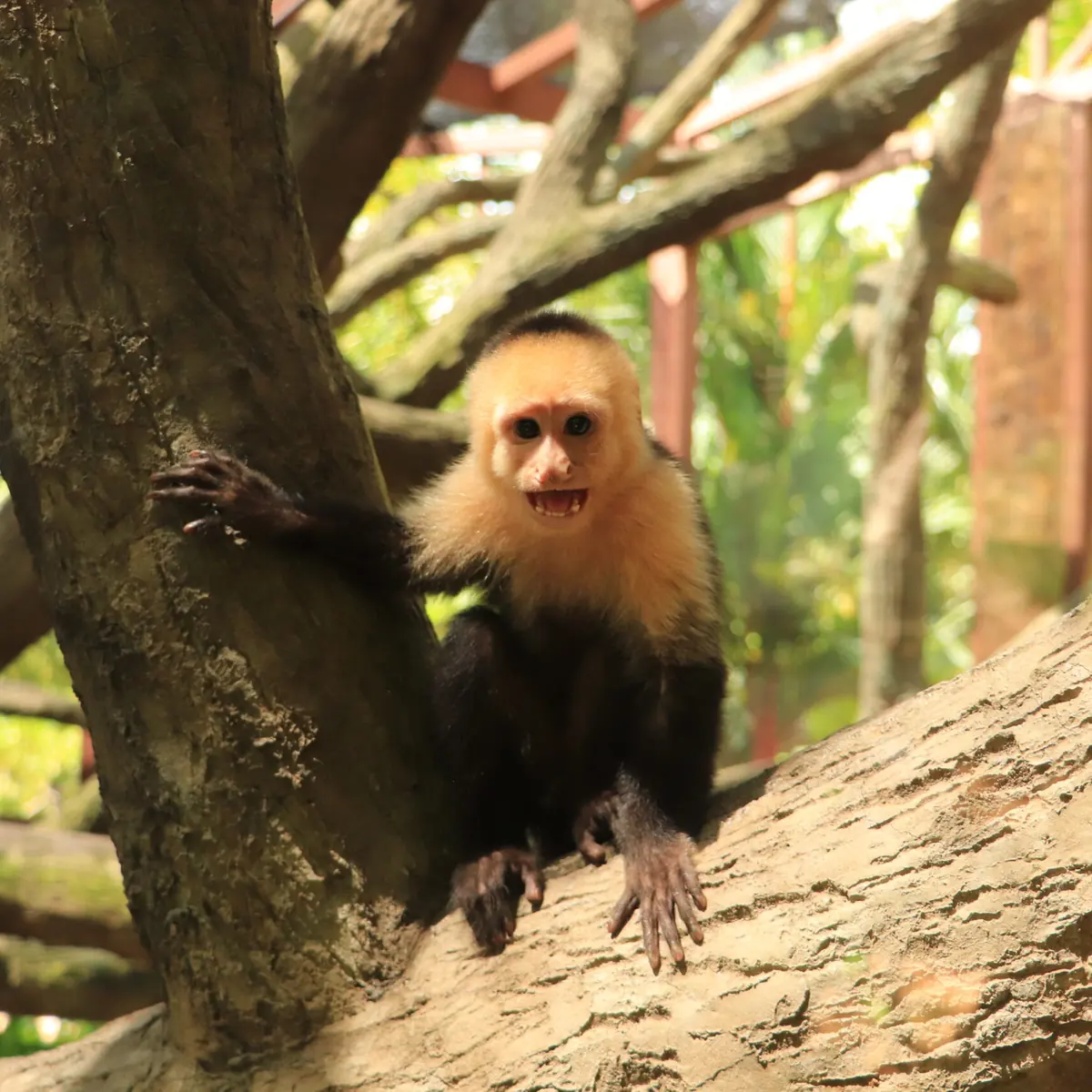
White-faced capuchins are curious, clever and always on the move. They use sticks and stones as tools, communicate with more than 30 different sounds, and live in troops of 8 to 20 animals.
Their name comes from the brown robes and hoods worn by Capuchin monks — the dark head fur and pale face look strikingly similar. In Costa Rica they are common around the coast, along with howler and spider monkeys.
Fun facts
Biologists at Diamante share these facts with guests on every walk through the sanctuary.
Capuchins use sticks and rocks as tools to reach food.
More than 30 different sounds, plus facial expressions and scent, carry their messages.
Their menu runs from fruit and nuts to insects, crabs, frogs and bird eggs.
The tail is as long as the body and can grip branches, though it is not as strong as a spider monkey’s.
Groups of 8 to 20 work together to find food, protect each other and raise young.
The name comes from the hooded brown robes of Capuchin monks.
They live from sea level up to 2,100 m (6,800 ft).
Up to 35 years in the wild, and up to 47 with care in a protected environment.
Meet ours
“Hola! I am Balú, the leader of the troop. You might recognise me because I only have half of my tail. But I am still the alpha male.”
Balú’s troop — Jerónimo, Margarita, Etiopía, Pandora, Yansy, Coquito and Jack Jack — lived in different rescue centres before SINAC concluded they could not survive in the forest and brought them to Diamante.
They were raised among people and in rescue centres, and lack the skills a wild troop needs. SINAC placed them at Diamante permanently.
Yes. They are one of the most common monkeys in the country, along with howler and spider monkeys, and you may see wild ones near the coast.